
What’s Actually in the CFPB’s 2026 Regulatory Agenda for Debt Collectors
The Consumer Financial Protection Bureau (CFPB) releases a regulatory agenda twice a year, and the collections industry reads each edition closely for signals about what is coming next. The 2026 edition, released July 6, signals continuity rather than disruption. For compliance and legal teams at lenders, servicers, and collection agencies, that does not mean there is nothing to track. This overview covers what is in the agenda, what remains a proposal rather than a rule, and what it means for a compliance program.
A Deregulatory Bureau, Not an Empty Agenda
The CFPB releases its regulatory agenda voluntarily, in conjunction with the Office of Management and Budget's broader Unified Agenda of Regulatory and Deregulatory Actions. This year's release is technically the delayed Fall 2025 agenda, and some items have already shifted since it was drafted. Across both the pre-rule and proposed-rule sections, the direction is consistent: the Bureau is devoting most of its rulemaking capacity to reconsidering, amending, or narrowing rules issued under the prior administration rather than writing new ones. Several items are explicitly designated deregulatory under Executive Order 14192.
The Item Debt Collectors Should Watch Most: The Larger Participant Test
The item with the most direct bearing on debt collection agencies sits in the proposed-rule stage: a reconsideration of the larger participant test that determines which nonbank debt collectors fall under direct CFPB supervisory examination. The current threshold, more than $10 million in annual receipts from debt collection activity, was set in 2012 and has not moved since.
The collections market has changed considerably since then. The number of agencies operating has shrunk from roughly 4,500 to as few as 2,500 firms, largely through consolidation, while the share of firms clearing the $10 million threshold has nearly doubled. More agencies today operate at a scale the 2012 rule did not anticipate, and the Bureau is now proposing to revisit where the line should sit.
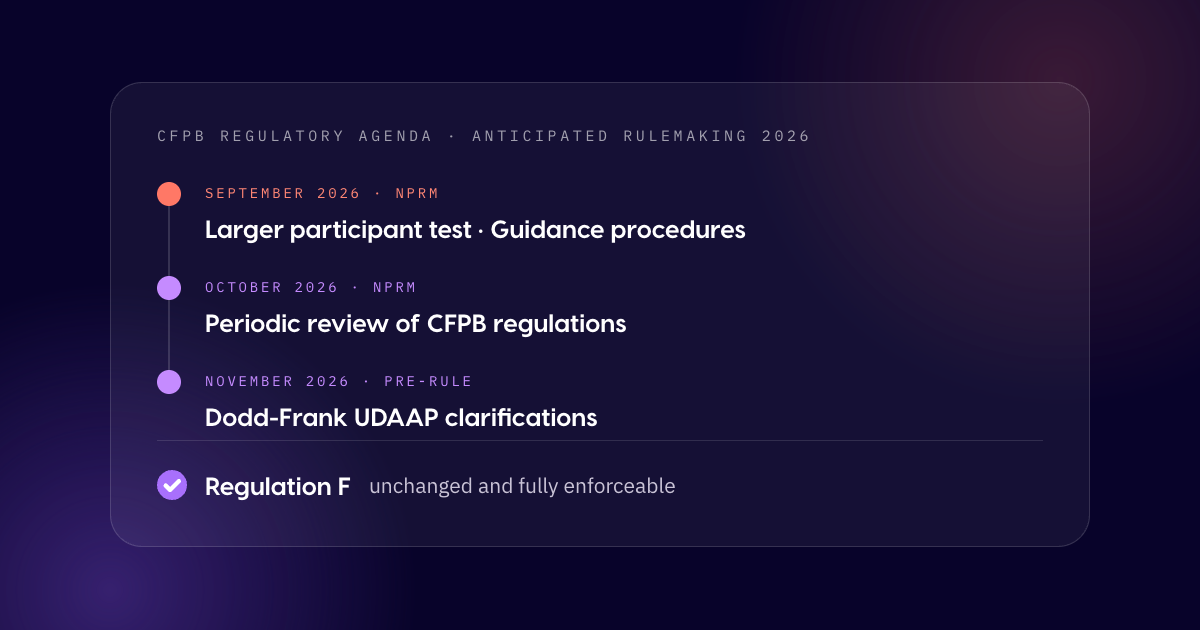
An NPRM covering debt collection, alongside similar reconsiderations for auto financing, consumer reporting, and international money transfers, is anticipated in September 2026. This follows an Advance NPRM issued in August 2025 and represents the next procedural step, not a rule change. A public comment period will follow before anything takes effect. Agencies operating near the current threshold, or that have grown through acquisition in recent years, should treat September as the point to start paying attention.
Other Items Worth Tracking
Periodic review of CFPB regulations (NPRM anticipated October 2026): would establish a formal, recurring process for the Bureau to review its own rules for outdated burdens. If finalized, this is the mechanism that could eventually bring Regulation F back under review, though not in this cycle.
Procedures for guidance documents (NPRM anticipated September 2026): governs how the CFPB issues advisory opinions, interpretive rules, and other informal guidance going forward. Relevant for any compliance program that relies on CFPB guidance letters in addition to the codified rule.
Clarifications to Dodd-Frank UDAAP provisions (pre-rule activity anticipated November 2026): still an early-stage item, but any movement on the statutory definition of unfair, deceptive, or abusive acts affects collections communications broadly.
What Is Not on the Agenda
Notably absent from the agenda is any proposal to reopen, rescind, or amend Regulation F itself. The Reg F framework that took effect in November 2021, including call-frequency limits such as the seven-in-seven rule, digital communication permissions, and the standardized validation notice, remains the primary federal rulebook for collector conduct. It is unchanged and fully enforceable regardless of what else moves on the Bureau's agenda this year.
What "Deregulatory" Does Not Mean for a Compliance Program
A deregulatory agenda should not be read as reduced compliance risk. The Bureau's shift is toward reconsidering specific rules issued under a prior administration, not toward eliminating consumer-protection obligations generally. The FDCPA and Regulation F remain in force as written. State legislatures and attorneys general continue to be active, and several states have enacted collection rules that exceed federal requirements. Private litigation under the FDCPA and Reg F also continues at a steady pace, independent of the CFPB's rulemaking calendar. A quieter federal agenda simply means more compliance risk is originating outside Washington.
The Practical Takeaway
The useful response to a regulatory agenda is not to react to each item as it moves, but to ensure operations can absorb whatever emerges from the September NPRMs without disruption. That means knowing which threshold an organization sits closest to today, monitoring the comment period once the larger-participant NPRM is published, and treating compliance infrastructure, rather than the news cycle, as the mechanism that keeps an organization audit-ready.
EQ Collect builds that documentation in at the placement level: contact-frequency monitoring, validation tracking, and immutable placement-to-disposition records that hold up when an auditor or regulator asks for proof. Whatever the September NPRMs ultimately change, that groundwork does not need to be rebuilt.
The information in this post is provided for general informational and educational purposes only. It does not constitute legal, regulatory, compliance, financial, accounting, or business strategy advice, and it should not be relied upon as a substitute for advice from your own qualified professionals. Reading this post does not create an attorney-client or advisory relationship of any kind.
Laws, regulations, and industry guidance change frequently and vary by jurisdiction. While we aim for accuracy at the time of publication, we make no representations or warranties as to the completeness, accuracy, or currency of the content, and we assume no obligation to update it. Any views expressed are those of the author and do not necessarily reflect the position of Equabli, Inc. Any references to third parties, products, or services are for illustration only and do not imply endorsement. Equabli, Inc. disclaims all liability for actions taken or not taken based on this content.